Showing posts with label #CE15. Show all posts

Friday, 30 October 2015

Going Beyond Pretty Quizzes

Going Beyond Pretty Quizzes – rich e-learning in Maths

Maths can be stimulating and satisfying, or it can be dry, mind-numbing and anxiety-inducing. As
educators we know the difference between activities that belong to each group. We're pretty good
at designing programmes which are rich and foster deeper levels of thinking. When it comes to e-
learning, however, that programme design doesn't seem to transfer. Many teachers just put their
notes online and make self-marking quizzes.

Firstly, I have absolutely no problem with online notes and self-marking quizzes. They're efficient and useful for our students, allowing them to access learning outside of class time and allowing us to reduce admin workload. It's worthwhile. It's engaging.
But if that's where we stop, then we're not enhancing the learning. These types of activities sit in the Substitution stage of the SAMR model for technology integration. And while there's nothing wrong with the Substitution stage - indeed sometimes it might be the best tool for the job on a specific day - we do need to keep pushing for that richer learning.
But if that's where we stop, then we're not enhancing the learning. These types of activities sit in the
been continuing along those same lines, running further iterations with that trial activity as well as
I'm on a mission to find the "good stuff". Why should social sciences get all the nice rich e-learning activities, I ask myself? I shared a bit about my own e-learning journey last year in a post for Connected Educator Month, where I mentioned an activity that I had been trialling. This year I've been continuing along those same lines, running further iterations with that trial activity as well as designing some more.
One activity in particular was both successful and a failure. That in itself was useful for me to remember that there is no one activity - e-learning or otherwise - which will magically engage and inspire and equip and challenge every one of the students in my class.


The activity was an investigation for NCEA Level One Relationships topic. I showed the students how to use Desmos and GeoGebra, gave them the assessment rubric and investigation questions and
away they went. For me, the hard part was writing the rubric (download Word or PDF), as this can
be pretty time consuming unless it's your kind of thing. (It's not my kind of thing.)
For the students, the hard part was the lack of structure. Some students needed a bit more guidance, so for the next iteration of this activity I will add in some differentiation and more concrete prompts for those who need it. Other students LOVED this activity. They really liked the open nature of the investigation and that they could go where their curiosity took them, guided by the rubric to ensure they still met the learning objectives for the activity.

My main takeaways from this activity were: 

 Open investigation still needs differentiated structure and guidance, but overall worked

 Access to reliable technology is still an issue!

 All students - including those who preferred a more structured model - said that they found

using Desmos and GeoGebra to be extremely helpful

 Providing hard notes is essential - I used this investigation as the main learning activity for

quadratic relationships, but after student feedback I made this notes handout to summarise

the learning objectives and make sure they had concrete notes to study for the assessment.


All in all, it was successful with room for improvement. Let me know what you've tried!

Stephen McConnachie
@s_mcconnachie


Thursday, 29 October 2015

To Blog or not to Blog - that is definitely the question!

At the end of last term, I made a conscious decision, which I have felt guilty about since then, to do ABSOLUTELY NOTHING related to school for the first 10 days of the holidays, I was tired, a little disillusioned and pretty damn well over a whole lot of things to do with school....hence I am only now getting to the '31days of blogging' being organised by Christchurch Connected Educators!!

I started blogging in 2007 after starting my MEd online at Waikato Uni. My thesis was entitled 'Keeping up with the digital natives: integrating web 2.0 into classroom practice'. 
After 'connecting' with Natalie Cowie, who was at KatiKati then, blogs really took off....
I blogged for my then Department - http://ideas4englishclassrooms.blogspot.co.nz


I got some of my Department blogging - http://chucker.blogspot.co.nz/
I ran a Library Blog - http://mrscsbookblog.blogspot.co.nz/
I ran a blog for parents - http://parentscount.blogspot.co.nz/

By the end of my thesis I was blogged out! But the data created was valuable - the half of the class that blogged about their work and writing gave and received more feedback and took part in more ongoing conversations about their work than the students who kept a logbook, as opposed to a 'blogbook'.

8 years on I still blog, but I run only two. I follow a number of blogs (which I regularly say to myself the number is not going to increase......). 

I blog to record my professional learning – schools visits I have been on; conferences I have attended and courses that I am enrolled in. I am currently enrolled in a PostGrad Dip  - Applied Practice - Collaborative and Digital Learning - run by The MindLab - http://themindlab.com/ I blog as I go – use my phone or tablet and modify and correct errors later. Adding photos and links from the lectures as I go is a breeze and I find working on the iPhone my ‘device of choice’. I find I can process and clarify thoughts as I go. 

I love reading – I still have a strong connection to the English Faculty and Library at my school. I regularly read and review teen fiction on our school library blog – Teen Arotake - https://teenarotake.wordpress.com/ - this is a part of my job that I really enjoy.


So that’s me…..how I got into blogging and why I still blog......

Alison Cleary - Rangiora High School
@AlisonCleary


Monday, 26 October 2015

The Purpose of Learning?

It has been a slow year for blogging, primarily due to the workload of balancing my pastoral role with another passion – leading and teaching a new Year 11 Science course. I have been able to explore and inquire as to the motivation and purpose of learning for my students, comparing and contrasting the students in this course with those in my senior Chemistry classes. Honestly, I have probably ended up with more questions than answers, but I have found one way to offer a course within a traditional school system which has the learning and the student at the centre, with NCEA credits being conveniently earned along the way.

Year 11 Practical Science

At the end of last year, I approached my Head of Department about redesigning our “Alternative Science” course. This was already a completely internally-assessed course, designed for students who struggled to achieve success in exam-format assessments. It was a meaningful and valuable course already; I just thought that it could be a little more student-centred and could offer more student agency.

The development and implementation of this course has been a real eye-opener for me, and highly rewarding for me, the teacher of the other class, and for most of the students who were given the opportunity to enrol in this course. I have been forced to become more fluent in a range of Level 1 Achievement Standards, and not just those in Science. I have learned a lot about the “credit-shopping” focus of students, regardless of their perceived ability and/or motivation. I have finally developed a way to support and guide less-organised students through portfolio-style assessments – it isn’t perfect, but it is a huge improvement on where we were at the start of the year!

If you are interested, you can read more about the journey in these posts:

We have designed a course which starts off with a Chemistry unit (because everyone loves mixing and burning chemicals) to teach observation and experimental skills. This is followed by a unit based around a Conspiracy Theory to teach about Scientific Literacy and research skills. The final prescribed unit is a Physics practical investigation to develop students’ Fair Testing. For these parts of the course, we kept a Class Blog to record the important content and skills:

The remainder of the year is focused on students’ interests and finding ways to structure these interests into robust inquiries. We had inquiries based on shotguns, MotoX, artillery, rugby kicking techniques, rowing technique, skateboarding tricks…it was amazing!

The teachers’ role is that of a mentor and (supportive) critic, while also being charged with finding suitable NCEA Achievement Standards to assess the learning with. As part of this, the marking schedules and portfolio coversheets have been co-constructed with the students. This has given transparency to the assessment and the expectations upon the students. This has also been the really time-consuming part, but also very rewarding!

The purpose of learning in this course has been, ultimately, to explore an inherent or developed interest and investigate it in a scientific manner. The wonderful outcomes have included most student earning at least 16 NCEA Level 1 credits along the way (some at Excellence level), outstanding student engagement, and a dramatic increase in students’ self-belief and self-worth.

“Academic” Courses

This year, I also had my philosophies regarding assessment challenged. While teaching the Year 11 course, I have also been teaching Level 2 and Level 3 Chemistry. These are courses where grades are ever-important. Most of these students are expecting to be shown how to excel in assessment tasks, sometimes regardless of the quality of the actual learning.

It would indeed be great to offer the same level of student agency and flexibility in these courses. However, the assessments do have the power to drive the learning in these classes. The day-to-day teaching and learning opportunities can be such that student choice and differentiated learning can be provided but, ultimately, there are externally-assessed examinations to prepare for.

There is no way to avoid the amount and specificity of the content that must be “covered” for these assessments. There is no escaping that students need to be coached how to answer examination-style questions at some stage through each unit. There is no avoiding the issue that to offer a meaningful number of credits, there is a LOT of work to get through.

If tertiary institutions put the main onus upon the externally-assessed Achievement Standards, courses such as Chemistry will always be driven by the assessment, rather than the learning. As I say, my philosophies have been challenged. By offering such an exciting course to the Year 11 “strugglers”, I have felt as though my senior chemists have missed out on the opportunity to explore the magic of their subject due the focus on grades. This is not a criticism, merely an observation…tinged with a little frustration, as I do not have the answer.

Why Are We Learning This?

Through two very different types of courses, I come back to that old adage from the disenchanted student, “Why are we learning this stuff? When will I ever need it in my life?” If you do not view these as fair questions, then I suggest you care more about your subject than you do about your students.

Student agency regarding contexts and, dare I suggest it, means of assessment are key components of making the learning meaningful to students. Surely this is achievable in Year 9 and 10, even in the silo of a single subject. Not to be disparaging, but context is even possible in Mathematics. NCEA is using contextualised questions more and more. What better preparation can there be than to apply mathematical skills to real student interests? I know that subjects like English, Social Studies and Science lend themselves more towards this type of learning, but Science is often prone to being too abstract if taken out of context and focused more on content.

If it is manageable in Years 9 and 10, why not beyond this? This is where the students’ respective reasons for learning become vital. Does the student sees learning in school as part of the journey to tertiary study? Does the student see learning in school as a way to learn how to learn, but has no (current) aspirations for further study? Does the student just want to be entertained until he/she finds a job that is interesting enough to do instead of being at school?

If the student sees tertiary study as the ultimate goal, then getting the grades to achieve this goal makes the learning authentic in itself. Courses that optimise this student’s ability to reach this goal are suitable. At the same time, these courses need to develop the whole student, of course, but the purpose of the learning is further study; the course must cater for this for this student.

If the student does not see tertiary study as the goal, then grades themselves (beyond getting sufficient credits to earn their NCEA Level 1 certificate, for example) are not going to be motivation enough. Authentic learning opportunities are vital for this student. Can the learning be applied to a hobby, interest, potential career…? This student’s course must provide enough flexibility and agency for this student to persevere with the learning, and to see the value of learning.

As I said at the start, I think I have more questions than answers. Do we need to offer two (or more) pathways for students in our courses beyond Year 10, in every school? How do we make them synergetic enough that students can shift course if they find their goals and aspirations have changed along the way? Regardless of the answers that are correct for your students, your school, and your community, when looking at your courses please always ask yourself what the purpose of the learning is.


Matt Nicoll – Year 10 Dean; Teacher of Science & Chemistry at St Andrew's College

Friday, 23 October 2015

Shaken but not stirred – unsung heroes.


Shaken but not stirred – unsung heroes


  1. The initial and ongoing care, support and energy of the teachers and support staff of children and their families following the earthquakes
  2. The emergence of the wide-ranging needs of earthquake toddlers and babies as New Entrants
IMG_3023

As principal of a school that lost over 1,000 houses in our school zone to the Red Zone we were approached by Dr. Carol Mutch (along with 5 other schools) to participate in a study about the role of schools in the earthquake recovery process. As part of this study we were fortunate to have funding and support from UNESCO. Over many visits and questions we kept coming back to one thing, something that was not widely reported or acknowledged

– the most important thing in the recovery of the children at school was the unwavering support of school staff. This was evident in the voice of the children, in the eyes of the parents and caregivers and in the grateful praise of school leaders. Teachers and support staff gave their attention and care to the children in their charge as they ensured their safety during the earthquakes, welcomed them back to school, listened to their stories and did all this while quietly putting to the side their own personal struggles. I was grateful of the opportunity afforded me in September by the University of Auckland to present a spotlight session at the British Educational Research Association (BERA) Conference in Belfast, Northern Ireland. During this presentation I told our story, but both Dr. Carol Mutch and I praised our teachers and support staff for the crucial role they played and, indeed, are still playing in the ongoing recovery of our school communities. While no medals or ceremonies were afforded to school staff their efforts, genuine care and selflessness is certainly recognised.
My second point above is an observation, no an obvious trend, which is charging into Canterbury Schools in great numbers and intensity. There are now many new entrants entering school with social, emotional and learning needs. These new entrants were toddlers or babies when the earthquakes hit. Now I am no psychologist or qualified behaviourist, however I am in my 20th year of principalship and in talking with other principals this is not isolated to my school. We have a greater percentage than ever of new entrants enrolling with high needs, including separation anxiety, high sensory reactions, and to put it bluntly throwing tantrums when they do not get their own way. My colleagues and I along with the RTLB service are sharing these observations with the Ministry of Education who are to their credit starting to realise the new tremors appearing across Canterbury schools. We now look forward to appropriate support for our new entrants and our staff.
In conclusion who are the unsung heroes of the ongoing earthquake recovery in Canterbury? It is the teachers and support staff who have continually been there for the children and families through the shakes, the emotions, the uncertainties and now the vast range of needs of children enrolling as new entrants. While outside Canterbury it may seem a long time since the horror of the earthquakes the recovery continues. Shaken but not stirred – hats off to our teachers and support staff, enjoy your well deserved break.
Jason Miles, Principal Kaiapoi North - @JasonMiles1970

Thursday, 22 October 2015

TECH TALK

Last term the Fendalton School Tech Wizards held a Tech Talk evening to share their digital learning with parents and teachers.

The purpose of the evening was for students to demonstrate the benefits of digital technology and how this helps them learn in the classroom by sharing their learnings and skills. More than 30 parents and teachers attended. It was great to see adults asking questions about the different programs and having a go at using them. It was also fantastic to hear the children confidently explaining the features and benefits of their chosen topic.


24 students worked individually, in pairs or in groups of 3. Their topics included Google apps, Movemote for recording videos, Scratch for coding and the Tech Wizards programme. The evening was run 'speed dating' style with two rotations of 7 topics, each held for 7-8 minutes.

Some students had previously spoken at the Burnside Cluster Learning Community Unconference and confidently presented their talks. For others, it was the first time they had shared 1-to-1 with adults so they spent the previous three weeks writing scripts, preparing examples and practising the delivery of their presentations at Tech Wizard time. Some were a little nervous at first but the students soon relaxed and enjoyed the experience!

"It was a really good experience to share our learning with others because some new people have now joined Tech Wizards." Georgiana, Year 6.

"It was nice for my parents to see what I do on digital devices because now they know what I can use for my learning." Hugh, Year 6

"It was a great opportunity for people to find out what they didn't know about technology." Lucia, Year 5

"I was quite nervous at the start of the Tech Talk but once I got the hang of how to say things and show things it was really easy and fun." Issac, Year 5


About the Tech Wizards
The Tech Wizards are a group of 30+ Year 5 and 6 students my colleague Carmen Dodd and I work with before school on Fridays. The focus for this group is to extend their digital technology skills and to assist others. They work towards criteria to earn digital badges and are encouraged to explore new technologies, share their findings and collaboratively problem-solve to find new ways to enhance their learning. To read more you can visit the ICT blog: http://www.fendalton.school.nz/ict/

Glenys Williams - Assistant Principal at Fendalton Open-air Primary School

Wednesday, 21 October 2015

Ignite Presentations and the Inquiry Cycle

At the beginning of term three I set a challenge to my Year 9 Religious Education class - to design aspects of their learning and adapt to barriers that arise. We started by looking at what GRIT, Growth Mindset and critique/ feedback look like. This provided the opportunity for students to realise learning is an on going process and that because they do not succeed the first time, it did not mean they were not developing their skills/ knowledge.
>
I asked them to design a challenge that they would complete focused on religion. To begin with students selected their own topic (I had a range from the Crusades to Secular Humanism). We discussed how to present their learning and one student offered the idea of a presentation style format. They researched different presentation formats and agreed on an Ignite presentation format. A basic run down of the Ignite Format:
  • Google Slides with a maximum of two words per slide - a focus on visual information.
  • Each slide would change every 20 seconds.
  • Students would complete a three minute speech focusing on three questions they had designed.
  • Parents and community members were asked to view the presentations and provide feedback for the students.
I introduced the class to the Inquiry Spiral which was the process we would complete in order for their Ignite presentation. This had a range of steps that I will briefly outline.
Screen Shot 2015-10-09 at 9.58.48 am
Scanning - Students were given time to identify key things related to their topic. This could involve factual information, key individuals or information about potential sub topics.
Focusing - Students formulated questions about one of the areas related to their topic. We focused on creating three Inquiry questions that followed the below format:
Question prompts.
Question prompts.
Developing a hunch - Students selected ONE of the questions they had created and imagined some of the answers or solutions to this particular question. This was a highlight in the process as individuals were able to draw on prior knowledge or ideas they had from another curriculum area.
Learning - Students were asked to think what they needed to learn about in order for them to test their hunch. Key question prompts included - Where will you find this information? Is this information reliable?
I found students were engaged in this process and produced amazing questions that they answered. I was surprised by their willingness to share their learning with their family and other students. When we had our presentation night students were given feedback through the rose, bud, thorn model. I wanted students to enjoy their first Inquiry for the purpose of developing skills/ knowledge rather than receiving a mark. Feedback provided from this model was honest and identified next steps for the students. They felt encouraged by this and commented on the skills they had developed through this process. We celebrated their success and they produced individual learning reflections which we shared on our Google Classroom page.
Learning Reflection after Ignite presentation.
Through this process I saw a massive change in the students attitude to learning and their willingness to take risks with their learning. For term four we are looking at the development of the Catholic Church in New Zealand and look forward to presenting Museum displays.

Jeremy Cumming
Cathedral College

Tuesday, 20 October 2015

Explore The World With Mystery Skype

MysterySkypeThis post was written for the Christchurch Connected Educators blog as part of Connected Educators Month of October 2015. You can read the original post here.
Mystery Skype is a fun activity being played by classrooms all over the world and presents a fantastic opportunity for students to become “global citizens” as they meet other students from around the country and globe. On their website, it is described as:
Mystery Skype is an educational game, invented by teachers, played by two classrooms on Skype. The aim of the game is to guess the location of the other classroom by asking each other questions.
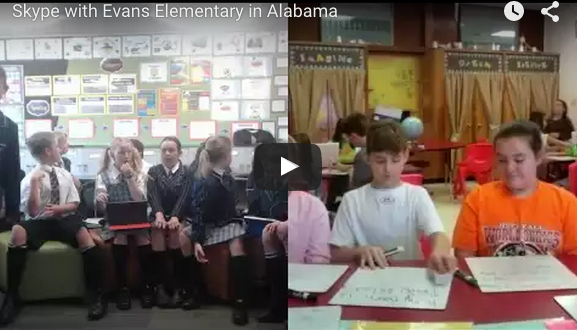
SkypeThe St Andrew’s College Preparatory School has completed many Mystery Skype sessions now, ranging from students in Year 3 through to Year 8 and the students always thoroughly enjoy the challenge of guessing the location of the other classroom. So far we have played with schools in:
Given the time zone of New Zealand, there are many parts of the world where it is virtually impossible to connect (although check out this Skype we did with the Viking Museum in York, where students came before breakfast to connect)
The Mystery Skype to Russia was one of the more exciting and challenging Skypes, as the class was very small and every student appeared to have a different nationality. It turned out that it was an International School set up by Shell Oil and all of the students had parents involved in the oil industry. Here is a video of our Mystery Skype (If you’re interested in recording your Skype calls, check out this affordable plugin):

It’s interesting seeing how different teachers have prepared their students to play Mystery Skype – the American schools often have very formalised “jobs” where some students are researchers, others are questioners, whilst others hold up signs confirming if a question was answered correctly or not. Ultimately, it’s up to each teacher how they choose to play, but preparing students to think about how to ask effective closed questions is critical since answers can only be “yes” or “no”.
The temptation for students to zoom in and ask very detailed questions is almost overwhelming. For example, given the amount of American and Australian television we have in New Zealand our students can guess the accent of the students very quickly, but they tend to then ask very narrow questions such as “Are you in Los Angeles?” or “Are you in Sydney?” Teaching the effective use of atlases is really helpful and can then lead to more useful questions such as:
  • Are you landlocked?
  • Are you north of the equator?
  • Are you on the West Coast?
One of the real privileges I have had helping classes with Mystery Skype is the sharing of Māori culture with other schools that may never have seen any aspects of it before. The students in our Preparatory School jump at the opportunity to sing waiata and perform the College haka and invariably the students overseas love it:

Mr Craig Kemp, the teacher at the school in Singapore and an ex-pat Kiwi, tweeted the view from his classroom:
CONCLUSION:
Mystery Skype is a fun way to connect with classes all over the world and I would really encourage you to give it a go. It is easy to find other classes thanks to the Mystery Skype website and our experience has been the other teachers are thrilled to find classes in New Zealand because they are often “so far away.” Once a connection is made, it is fun to then re-connect and ask questions of the other class for curriculum related topics e.g. if you’re studying weather patterns or transport, why not Skype that class in the US and find out their experiences or views on these things? Finally, Mystery Skyping is contagious – once classes find out their friends in different classes have done it, they start asking their own teacher to get involved. Have fun!
Sam McNeill - Director of ICT at St Andrew's College, Christchurch 

Sunday, 18 October 2015

The Power of Collaborative Critique

The power of Collaborative Critique

I like how he tries to make art accessible to all students and help them appreciate 
and understand art and different ways to gain inspiration.

As part of the teacher appraisal cycle, I am presently reading teacher inquiry reflective diaries. Each teacher has carried out an inquiry into their practice and had the opportunity to share their journey at 3 quality learning circles (QLCs) throughout the year. Using strict QLC meeting protocols teachers have presented and critically reflected on their practice showing how a specific intervention has impacted on student progress and achievement. It has also helped them to clarify their next steps on an accepted continual journey of self-improvement.


I like the way she is concentrating on helping students to verbalise their learning more, to explain more deeply, and how she linked this through to student led conferences.

Teachers have also critically reflected on the inquiry presentations of their peers making connections to their own inquiries posing questions, making conclusions and utilising practical ideas. The most valuable part of teachers as listener learners at QLC meetings is their ability to give written feedback to their peers about their practice in situ, with deep respect and meaningful comment.

Her desire to make students passionate about ----- is clear. A true focus on the experience rather than the outcome has been very successful.

After they have listened to a colleague share their inquiry and critical reflection on their practice, each teacher then reflects in their diary making connections to their own practice. This is a practice that builds a collaborative culture based on true respect and trust.


The following peer feedback comments are powerful examples:

Conclusions made:
·      I can see using video to record student progress is powerful!
·      It is important to include reflection time in all areas.
·      Less teacher talk leads to student self regulation.
·      I realise how important it is to break down goals and to scaffold helping the students to reach their goals over time.
·      Children learn more when they formatively assess the work of their peers.
·      It is important for students to understand the real life connections to all learning.
·      Too often I concentrate only on the girls when concentrating on myself would allow me to be more reflective and make changes to be a better teacher.

Specific feedback about practice:
·      I love that she is trying to empower her students to be “little authors”.
·      I really liked her ideas for P4C, the written point/counter point activity sounds very exciting and provocative.
·      Her SRL ideas are fantastic! The programme is well thought out and it has reaffirmed my thought that reflection and goal setting/planning are vital.
·      I love her use of SCAMPER. He is encouraging the girls to self-judge/evaluate.
·      Love how her frequent formative assessment allows her to be more responsive.
·      She showed us great use of peer review and self-critique.
·      I am always so impressed with her skill in working with the girls to develop their IT abilities.
·      Her passion for not only teaching but also capturing the moments of learning is inspiring!
·      She did a fantastic job of capturing verbalised reflections. I can see how I could implement this effectively and gain powerful results.
·      She has done a superb job of asking students how they want to share achieved goals and progress.


And finally, a comment from a teacher about their QLC peer group:

Always impressed with the level of professionalism.

The QLC and reflective diary is an important feature of a multi-faceted appraisal and growth programme that helps me as a principal to clearly link my intent to that of my teachers. Like students, getting teachers to articulate their practice, share their reflections and clearly state their next steps is not easy but is crucial!
Peer coaching includes similar practice, that is spotlighting one aspect of practice and deep questioning, however the QLC model adds the listener learner aspect resulting in critical reflection from all teachers in the group. In the process they question their own beliefs, values and assumptions and are challenged to examine their practice.


As Mielke (2012) states:

When adult learners are empowered to objectively analyze and understand their own practice and have a clear vision of where they can improve, they are intrinsically motivated to embark on a pathway that leads to expertise.

 Thank you, teachers, I applaud your self-assessment, self-direction, reflection on practice, and professional conversation and moral practice.

So, is your school a listening, learning school?

As part of your teacher inquiry process do your critical reflective questions take thinking well below the surface and actually challenge your mindset?


Does your inquiry process support innovation, allow success and risk taking? If yes, to what extent?