Showing posts with label Rolleston College. Show all posts

Monday, 3 April 2017

Impatience

Impatience.

It was a damp Sunday last weekend and with no Premier league on this weekend it was a perfect time to catch up on some of the articles that have come into my Twitter account recently.
The first one was an article titled, “Re- Imagine Space For Learning”  by Alastair Blyth. As I am the principal of a new secondary school this was a  topic that was of particular interest to me. The debate about the functionality of flexible learning spaces in schools continues to rage in New Zealand, to the point where we often seem to be focused on the buildings and not what is happening within them.
There was nothing in the article that I could disagree with, far from it, I was in total agreement with all that Blyth said. Statements like the following made perfect sense to me.
“Accommodation no longer consists of uniform classrooms, each equipped with thirty desks, a teacher’s dais and blackboard. Standard classrooms give way to a variety of spaces… Space for work in small groups, for discussions, for seminars, space for independent study and investigation.”
The comments around the importance of using all spaces in a multi-functional way also resonated. The need to see the canteen and corridors as legitimate learning environments is something that I personally feel very strongly about. Learning can and must take place anywhere and everywhere.
As I am working in a purpose built physical environment that offers a wide range of learning spaces to accommodate a wide range of learning environments and expediences, this was an article that I could easily relate to.
The next article I read was  Dr Lucy Hone’s column  published in  the Sunday Star Times magazine. I have been fortunate enough to hear Dr Hone speak recently and was profoundly moved by her words, especially those comments relating to  the responsibility we all have to ensure and maintain the well being of our children, so I read anything she writes with interest.
This weeks article was on the concept of Grit, a concept that is currently a hot topic in education circles.  The article talks about grit as being defined as passion, purpose and perseverance. It talks about emphasising the importance of showing up on time, working diligently, sticking with the task even when it gets tough, being respectful and handling honest and sometimes critical feedback. All of these are ways that an individual develops the grit necessary to have the strength to face challenges.
No argument there. Much of what we did at Rolleston College in our first few weeks was designed specifically to ensure that our learners were in a safe and supportive environment where they could be encouraged to develop their perseverance or grit.
Back to Twitter then and an article written by Shelley Wright.
Again all of what she said struck a chord, especially when she talked about how important it is that young people discover what they are passionate about while they are at school. That they should discover that they can make a difference now. That they should leave school knowing what the are good at not just whether they are good at school [or not].
She went on to claim that that as they grow young people lose their natural sense of curiosity  and how they need to;
  • learn how to learn, fail and learn some more.
  • constantly ask and be asked three questions. What are you going to learn? How are you going to learn? How are you going to show what you’re learning?
Nothing here that could not be taken directly from our school vision and values statements.
So far so good, The next article was a report of comments made by Mark Cuban, billionaire software developer and owner of the Dallas Mavericks.
The essence  of what he was saying was that as computers become increasingly sophisticated an increasing number of what we see as occupations will disappear. To the extent, he argues that the key skill that will be in demand in the world of work in the near future is that of creative thinking. This is where he says that some of the ‘creative thinking’ areas such as the learning of languages or studying philosophy will become increasingly relevant for the type of thinking and creativity mind sets that they develop.
Cuban argues that we need to be aware that, “community building and creative thinking to create social impact,” are going to be increasingly important in the workplace.
Again no argument from me, I have long advocated the need to develop and foster creative thinking in schools.
Moving on then to  Christiaan Henny and an article claiming that traditional academic content focussed learning is an inefficient and ineffective way of enhancing learning. Henny identifies the following nine factors that will shape education in the near future.
9 Things That Will Shape The Future of Education.
  • Diverse time and place
  • Personalised learning
  • Free choice
  • Project based
  • Field experience
  • Data Interpretation
  • Exams will change completely
  • Student ownership
  • Mentoring
Yet again this article is synonymous with the way we are delivering learning through our three learning vehicles at Rolleston College.
All of this should have filled me with an inner warmth on an increasingly grey morning. Surprisingly it didn’t, in fact it left me feeling quite annoyed.
So why did a series of articles and reports that only supported the educational direction of Rolleston College cause such annoyance?
I guess the main reason is best shown by the flowing diagram;
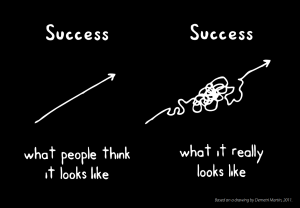
Success
The theories all make perfect sense, they are rational, logical and similar to the straight line on the left of this diagram. The reality on the floor is a little messier though. It involves people, limited hours, administration and bureaucracies. In short real life is a tangled line.
I am by nature an impatient person, in the words of Freddy Mercury, “I want it all and I want it now.”
So the tangled line, that is the real path to success means that after eight weeks everything is not perfect and not every question has been answered.  Having the patience to work through this tangle is ultimately what was annoying me.
This though is our reality, smooth seas never made a great sailor and nothing worthwhile is easy so every time I feel impatient, frustrated or annoyed I have learnt to sit down, calm down and reflect.
Time then to reflect on what I had seen in the last week or so as I had visited learners,  escorted visitors and generally wandered around the various learning spaces. What had I seen?
On Friday I was sitting in one of our meeting rooms in a cluster meeting with local primary school principals. From my seat I could look down one of our circulation corridor areas and watch with interest one of our teachers on her hands and knees in the corridor with a group of learners also working  measuring , cutting, assembling,  and racing backwards and forwards totally engrossed in a learning activity that was obviously something to do with Maths. Every part of me wanted to race out there and see exactly what they were doing but I didn’t, I just smiled as I observed how learning can take place anywhere. So this is what Blyth means when he refers to the multi functionality of space.
Later in the day I sat with three learners in the coding class. it would have been easy to be impressed by the web page that one of these 13 year olds had developed, animations almost jumped out of the screen, it looked professional and aesthetically well designed. What was more impressive though was listening to how she guided her peers through their web design whilst continuing to work on her own project. Here was a fully functioning team, each working on their own projects but where one ‘expert’ could assist and guide.
A first hand example of academic mentoring.
Minutes later I heard a conversation between a teacher and a learner about his project, designing and building a skateboard ramp. The conversation was about where he was going to access the materials to construct the ramp. The teacher was not providing the materials, the teacher was not even saying where they could be obtained from, the learner had already figured that out and was about to make some phone calls to arrange sponsorship to assist with the purchasing of these materials. The teacher was saying that they wanted to see the script that the learner had prepared to guide them through these phone calls. In other words the teacher was not making it easy for the leaner but they were ensuring that the learner was being guided through the tricky phone calls and ensure that they were well prepared for the phone calls before they made them. So I was observing project based learning and genuine learner ownership and accountability with the teacher supporting.
Our learners are busy working towards completing their first individual Quest project  where they follow a passion with the aim of producing an event or artifact. As  a result quite a few of my observations at this time related to these Quest projects. The day beforehand a group of three learners ran their cake stall that was the first part of their Quest work for this term. I could talk about the learning that went with this fairly straightforward project [budgeting, advertising, cooperation, social awareness in choosing the charity that they were going to support etc. but what really struck home was when I came across some further work that one of these learners had just completed. Working on her ‘nature verse nurture’ assignment she had decided not to just write an essay but instead use an app that enabled her to develop a visual presentation on an iPad and by holding your phone over the visual you activated her prerecorded narrative. I came across this when it was being used by a teacher to engage two boys who were struggling with the task as a way that they might be able to present their work. This particular learner is quite a shy and reserved learner yet in two situations I had seen her lead, innovate, create and provide material that was helping in the learning of others,  I had seen her feel confident enough to make herself totally accountable for her own learning and feel the genuine sense of accomplishment that comes from operating just outside of what is comfortable. Her confidence was being transferred and as a result her engagement was soaring.
The list of precious moments continued. I watched a group of our learners practice the school haka that some of them had written and  remembered the conversation that I had had with a learner about the personal karakia [prayer] that  she had written as part of their learning and another conversation with another learner about the research she was doing into her iwi [tribe] and the stunning artwork design she had completed that represented her iwi.
All of these learners felt safe enough to explore their Maori identity and were excited about what they were discovering about themselves in the process. The fact that the Te Reo teacher who had created this supportive environment and had encouraged them is but eight weeks into his teaching career is in itself an amazing accomplishment.
As I reflected further I thought of how a group of our Mandarin learners presented their language skills to a full school assembly and how our French learners had suggested the French language song for out bell music of the week so that other learners could experience hearing a language that they were rapidly growing to love. Examples of learners who are demanding to showcase their learning and be accountable for what they are achieving and wanting to share this with their peers.
Sure these are small examples but when they are added together they start to paint a picture, that our tangled web is heading in the right direction and on the way sparks of creative thinking are stating to ignite. So the group of learners working with a local supermarket to trial boomerang reusable shopping bags are not only showing their entrepreneurial skills but also a sense of social awareness and responsibility, they are taking their learning beyond the school and out into the community.
Yes maybe I am wearing rose coloured spectacles but it is hard not to get excited when I watched a learner in our recently completed three way partnership conversations hold her parents and her Ako coach captivated as she led them through her E -Portfolio that showcased her learning. Here was a 13 year old speaking with confidence and considerable animation and holding adults in the palm of her hand.  A further example of learner accountability and ownership.
I stopped reflecting at this point, I was comforted that as we journey down our tangled path I could easily see specific and real examples of all the features that the readings I had just completed had identified as being important and vital. We were doing it, even more important our learners were doing it.
Visually it looks a bit like the picture below.
We often refer to our whakatauki,
He kākano i ruia mai i Rāngiatea.
The seed will not be lost.
Well  it feels like the seed is bursting through the surface. It is still a young seed but all of the examples above are our little seeds and they are growing, slowly but surely.

plant-growing-through-pavement
And then as Sunday afternoon loomed I wasn’t annoyed anymore, still impatient, still wanting to clear the tangles into a straight line, still wanting to speed up the growth of the seeds but that is the reality of a life in education.

Sunday, 12 March 2017

Prove It!

Posted on 16 February 2017 Cross-blogged from HERE, with permission.

Last year, none of my Selected options had enough enrolments for the courses to run in Term One, 2017. Instead, I was asked if I wanted to take a class of "Proof", a course about forensic science and New Zealand law. Fortunately for me, and sadly for two other staff members who did the original course design and brief, there was a timetable clash which meant I was being offered the chance to lead one of the two classes of Proof.


A lot of planning went into getting this course ready and making it feel authentic, including writing a script for the first crime scene, setting up a crime scene, and preparing the evidence for the students to use. Some amazing colleagues gave up their own time to help with staged interviews, to plant evidence leading to them as suspects, and even to pop into class to be grilled by the students.

Today was my first 100 minute block, and all of the effort was worth it. I can honestly say that was one of the most invigourating, enjoyable "lessons" that I have ever "taught". Not only were the students engaged, they were challenged and having fun. Word must have got out, because we had a lot of visitors during the lesson...

It was a huge relief to see that our crime and available evidence is not too easy to solve. They may only be Year 9, but these students have already exceeded my expectations in other things in the first few weeks. Luckily, we have written in enough stumbling blocks and misdirection to keep them engaged, entertained and driven to succeed. They have been asking questions that I never considered when writing the script. Overachievers!!

We are very lucky. This is a Selected course, so students opt into it. We also have two uninterrupted 100 minute blocks on subsequent days (Monday and Tuesday for one class, and Thursday and Friday for my class). We have a small roll in a big school, so can close off a lab to set up as a crime scene. Only the last of those things will change in the future, and it is definitely not an insurmountable barrier.

I am buzzing at the moment, more than I ever have after a lesson in 17 years of teaching. I am genuinely excited about what lies ahead in Proof...

The grand plan goes something like this for "Proof 1.0":
Week One: Use evidence to solve a crime scene - Crime Scene #1. The evidence has been collected for you and suspects interviewed. Now use this information and your own observations to create a timeline and deduce "whodunit".
Week Two: Reflect on Crime Scene #1. What went well? What did not? Reveal the true story and reflect on our own conclusions and assumptions.
Week Three: Learn about some forensic and other crime-solving techniques via online games. Students will decide which skills they want to become experts in. We will seek out experts (and do some actual teaching and experiments, of course) to help students become competent at, for example, collecting and analysing fingerprints, or interviewing suspects, or collecting and analysing fibres. The students decide, we guide them to those who can help...
Weeks Four-Six: Learning skills and proving competence and/or proficiency in these skills. During this time, I will be writing Crime Scene #2, based upon the skills the students have elected to learn.
Week Seven: Crime Scene #2
Week Eight: Reflect upon Crime Scene #2. The class then plan and set up Crime Scene #3. This may be a Murder Mystery evening for teachers, parents and/or friends. It may be something completely different. The students get to choose how to celebrate the amazing learning they have achieved.

Author's Note: Since writing this, there has been a change to the plan. More time has been needed for the exploring of key ideas, such as eyewitness testimony, which has put things back a bit. I am now co-writing Crime Scene #2 with one of the learners, and this will be the foundation of the Celebration of all ākonga learning. It may still be something we set up for friends, kaiako and/or whānau, but time constraints have forced a small change to the plan laid out here. M

We will be offering learning experiences beyond the obvious scientific observation and analytical skills. "Proving" is tougher than "knowing". Writing convincing arguments. Articulating convincing points of views. Weighing up the value of evidence. Formulating questions for interrogations. Using evidence to catch people out on a lie. Teamwork. Resilience (there will be deception in Crime Scene #2, so students will get frustrated). Science. English. Social Sciences.

Then, we are looking at where we go from here: Proof 2.0. What will the next level of course look like? When will it be offered? Just for Year 10? For any student from any year level who has completed Proof 1.0? Will the timetable allow for that? Should it? Will Proof 2.0 provide opportunities for students to earn NCEA credits? Should it?

This is what teaching can be like. This is what learning can be like. And I get to do it all again tomorrow...

Monday, 24 October 2016

Day 24 -Why do we have to change?

This post was written by Rob Ferguson, one of the foundation teaching staff at Rolleston College/Horoeka Haemata. His blog can be found here.

I've started a new job! It's a unique opportunity. It's at a brand new school, so new in fact it's still wrapped in plastic as I type. This means we have term 4 to reflect on the past and what the future could and will look like with out the pressure of students.

At Rolleston College we are going to be doing things quite differently from the ways of the past. Dr Julia Atkin in so many of her presentations about change says you should first of all ask the question 'Why?'. In the two weeks leading up to starting my new position there were a couple of links to articles that turned up on social media that are part of the answer that question for me.

The first was written by Nigal Latta for the Star Sunday Times outlining his thoughts on the direction the New Zealand economy needs to evolve. For me his second last sentence says it all "it's that they find little niches in the world market and fill them." I'm no economic expert, but to me, it seems the best way for a small country in the South Pacific to compete on the world stage.

The second 'Nigal Latta only tells half the story on the economy' was by Geoff Simmons for the Morgan Foundation. In it he talks about how more than half of our national wealth is in housing and the affect this has on our businesses ability to step into overseas markets.

To effect change that can address the issues outlined in these two articles, we need to look to our youth. No pressure on teachers, but if we do things differently in education, then maybe in the near distant future things will start to change more in the New Zealand economy.

The interesting thing, is the inspiration and exemplars are out there. At the same time I was reading the above articles these two came out. One on Jamie Beaton and his Crimson Consulting company raising of capital in New York. Tech based companies are an obvious direction but not the only one. This article on Celia Robinson, group  co-CEO of Myfoodbag gets you thinking how big could it get?


Dan Pink in his book 'A whole new mind' talks about the world entering the 'Conceptual Age' and suggests that to survive and thrive in this age you need to ask 3 simple questions. Can a computer do what you do faster? Can someone in the world do what you do cheaper? Are you producing something in demand in the age of abundance? If you answer yes to the first 2 and no to the last, things will be tough.

I like what Dan has to say in his book and the two examples of success above answer his questions in the way they need to in the conceptual age. 

Sunday, 23 October 2016

Day23 -Subject Communities, not Silos...

During the week, two of our tasks at Rolleston College/ Horoeka Haemata involved the unpacking of two Learning Areas from the New Zealand Curriculum: one given to us (not one we strongly identified with – unfamiliar text, you might say…); and the one we most strongly identified with. For me, this meant the first task was to try and unpack Health and Physical Education and to present what I thought to others, one of whom was actually an HPE specialist! For the second task, I worked with another Science specialist to unpack this Learning Area, and present the key elements (and “non-negotiables”) to all other staff.


One of our Senior Leaders talked about how we needed to be respectful when unpacking Learning Areas that were not our own. He addressed the term “Silos” that keeps being bandied around. He explained that he preferred to think of these more as Communities. This resonated with me. These Communities are populated by people. These people have adapted to be successful in these Communities. These people know what the key elements are for being successful in their respective Community. These strengths and predispositions need to be respected when we try to communicate which elements we see as being important in our new Community of Learning…

If we think of Silos instead, it is very easy to forget the human side of the Learning Areas. I know that I immediately think of each Silo being a different part of a machine, doing its own unique and important role, that contributes to the functioning of the machine we call Student Learning. To get those Silos (machine parts) to work together successfully takes a fair bit of coordination. It often takes students a long time to see the connections between the parts. I guess this analogy works for me as well, but it lacks the human element of Communities. I like the human element.

What about those tasks?

Unfamiliar Learning Area

He oranga ngākau, he pikinga waiora.
We were given a period of time to try and break the Learning Area down into 20 (or so) words/key points. From this, we had to break it down into only five!! When discussing multi-disciplinary learning with peers in the past, the common concern has been about the potential for “dilution” of content and key skills. This thought struck me again – only five words/key points?!

Once I started, it was surprising how easily this Learning Area unpacked. A couple of different ways to arrange the Learning Area quickly evolved for me:

Four Strands/Contexts
  • Personal Health and Physical Development
  • Movement Concepts and Motor Skill
  • Relationships with Other People
  • Healthy Communities and Environments

 Four Concepts
  • Hauora
  • Attitudes and values
  • The socio-ecological perspective
  • Health promotion

Ultimately, though, I felt that everything emanated from Hauora. Therefore, I felt I had my five words, so long as I showed their interdependence with arrows:


Then came the tough part. Share this with someone from the HPE Community. When I fleshed out my simple little diagram with some thoughts about context and content, this was received much better than I thought!!

Familiar Learning Area

Mā te whakaaro nui e hanga te whare;
mā te mātauranga e whakaū
The task for this seemed much easier. It was the same task but within “my” Community – Science. I worked with another member of the same Community. This should be easy, surely! Not so. Within our Community, each member seems to put different value on different elements of the Community. That is natural.

However, what prevented this becoming a barrier was how easily these could be fleshed out. We were speaking the same language. We were able to group, classify and categorise our own ideas into bigger pictures under the “Nature of Science” umbrella. Finding five words/key concepts was, ultimately, not too tough (being familiar with TKI helped a lot with this, too!!):
  • Evidence-based
  • Knowledge is Provisional
  • Uses Models and Theories
  • Influenced by Society

We then unpacked each strand (Material World, Physical World, Living World, and Planet Earth and Beyond) into a couple of key “non-negotiable” points. These were the elements we felt were non-negotiable and may not be “diluted” by involvement in multi-disciplinary learning. Student learning must include the key elements (content and/or skills) of Science we identified. Boiled down, we did really get it down to:
  • Matter
  • Energy
  • Forces
  • MRS GREN
  • Ecosystems
  • Inheritance
  • Cycles

Throw in some critical thinking, and I think the key words and non-negotiables cover the nature of the Nature of Science. The excitement came from hearing how other Learning Areas were unpacked, and seeing how Science could complement each of those “Communities” without diluting either. 

In fact, I can imagine how each Community (Learning Area) will be enhanced, along with the overall learning of each student, by having natives from each Community involved in each multi-disciplinary module. The NZ Police may build “Safer Communities Together”, but we will build “Stronger [Learning] Communities Together”.


Matt Nicoll is one of the foundation teachers at Rolleston College/Horoeaka Haemata. His blog can be found here. 

Friday, 21 October 2016

Day 21 Can There Really Be A Unicorn School?

Today's post is by Sophie Ralph, the Hauora Leader at Rolleston College/Horoeka Haemata.
images
I recently read an article in the Harvard Business review about ‘unicorn’ businesses, such as Uber, and how they have grown from simple ideas to worldwide business models which are challenging the status quo. HBR How Unicorns Grow. It made me think of kura in New Zealand and of course worldwide who are challenging the status quo and pushing for dramatic change in our education system of old.
After reading this article it made me think of how starting with a clean slate we could in-fact grow a unicorn. We would not be the first to try it and our unicorn may be different to others but with all mythical creatures we have our own interpretation. I like to think that a unicorn has a little bit of magic and all learning institutions have this but how do we use this ‘little bit of magic’ for good rather than evil. A tad dramatic possibly, however all researching on educational change is pointing in a certain direction but many are hesitant and fighting to stop ourselves from going towards the light.
What would a Unicorn School have?
Magic – This can be seen in the people within the unicorn school who feed and nurture the unicorn from a young age. People who care, people with passion, people who are invested in the values and mission of the kura. People who have a strong moral purpose for all learners, a moral purpose that to goes beyond the school gate with learning and support. I see this happening a lot already in many schools. All staff, sports coaches, cultural tutors, mentors and administrators often go above and beyond harnessing and exploring the passions  of students. Looks like we already have magic covered.
Ideal Growing/Living conditions – An environment that learners are connected to both the physical and spiritual world. An environment that is not ‘cut off’ from the resources that it needs. An environment that nurtures growth and safe exploration within the surrounds. An environment that explores connections to local and global networks, this can be achieved through online connections or face to face connections from the magical people previously mentioned. Conditions that feed the belly, soul and mind. Looks like we have ideal growing/living conditions covered.
Ability to Fly – This could be tricky but if we take the time we can often see learners challenging themselves with difficult tasks and challenges that they set themselves. I guess it depends on your definition of flying. To see a learner fly under their own steam and from their own creations, even if at times a little close to the sun. The magic and living conditions support them to fly.
With all the things mentioned above in place why are schools acting more like unicorns? We are so bogged down with meeting national standards assessment has begun to drive learning. Reporting back in a way that makes a child a level or a number is pleasing for whanau. We accept this. Hearing discussions  that “My child is above average” congratulations, above average how about inquisitive, curious, and creative. Would you like to be described as above average in your online profile, would you write this in an application letter. “I am above average and can meet deadlines”….I would rather be described as creative, curious and caring. Don’t get me wrong standards are important and a robust education system with appropriate checks and measures in place are important but lets be more like a unicorn. Whatever you want that makes you magic and able to fly.
Upon sharing this article with another teacher I was told unicorns are a lovely idea but not real….but they could be. Let’s do it, watch this space.
unicorns-missed-the-ark-495px-495px