Showing posts with label Connectedness. Show all posts

Tuesday, 4 October 2016

Oct 4 - 31 Days of Blogging - Are you on Twitter?


What is Twitter?             Day 4 - Twitter / Tīhau     
Are you on Twitter?       (@paulinehedog)
If you are reading this blog post, you are likely to be on Twitter, as the link is being sent out via Twitter and also emailed to other educators who follow this blog. The extract from the CENZ16 Starter Kete below explains "what is Twitter"
"Just as many educators have readers and subscribers for their blog (as you may have), you have “followers” on Twitter. Your followers see your messages (called tweets or updates) as you tweet them, along with the chronological tweets from all those they follow.
You can also connect and communicate with your followers and those you follow via “@reply” tweets, so it is far more than just sending messages out. Many educators are now discussing concepts and ideas and their practice through Twitter.

Tip: ‘@’ is the symbol that goes in front of people’s Twitter names e.g. @ConnectEduNZ"
"Why would I join Twitter?" is a question I get asked many times and it is often difficult to explain the "why". Because the why or the purpose may be different for  different people - but for me the 
answer is connecting with others, sharing and gathering ideas, creating a PLN (personal learning network). I heard Kevin Honeycutt, (@kevinhoneycutt) a well-know American educator talk about the "11,000 educators" he had access to in his back pocket and that was my "aha" moment. Since then I have built up my list of people I follow, who have knowledge and ideas to share. 
I have many Education "heroes", people whose books I read, who have spoken at conferences or workshops I have attended and have been privileged to meet some of them. And there are many, many innovative teachers I know who I follow on Twitter or I join in regular Twitter chats. Why wouldn't I follow them on Twitter to be connected, inspired and share great ideas?
A word of warning: "choosing your Twitter handle can be as tricky as naming your new dog, so a good idea is to keep it short and simple. If you can use your own name or part of it even better. 
Take a leap of faith and try it - And in the theme of "Kiwiana" here at uLearn - "it's got to be good for you"




Tuesday, 20 October 2015

Explore The World With Mystery Skype

MysterySkypeThis post was written for the Christchurch Connected Educators blog as part of Connected Educators Month of October 2015. You can read the original post here.
Mystery Skype is a fun activity being played by classrooms all over the world and presents a fantastic opportunity for students to become “global citizens” as they meet other students from around the country and globe. On their website, it is described as:
Mystery Skype is an educational game, invented by teachers, played by two classrooms on Skype. The aim of the game is to guess the location of the other classroom by asking each other questions.
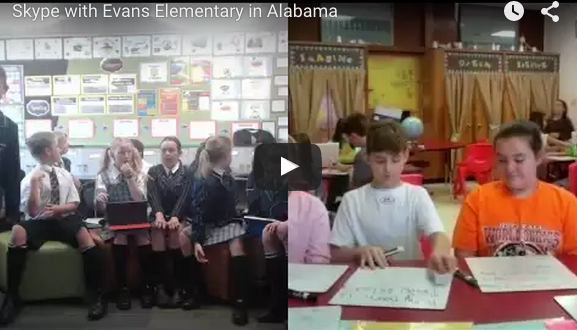
SkypeThe St Andrew’s College Preparatory School has completed many Mystery Skype sessions now, ranging from students in Year 3 through to Year 8 and the students always thoroughly enjoy the challenge of guessing the location of the other classroom. So far we have played with schools in:
Given the time zone of New Zealand, there are many parts of the world where it is virtually impossible to connect (although check out this Skype we did with the Viking Museum in York, where students came before breakfast to connect)
The Mystery Skype to Russia was one of the more exciting and challenging Skypes, as the class was very small and every student appeared to have a different nationality. It turned out that it was an International School set up by Shell Oil and all of the students had parents involved in the oil industry. Here is a video of our Mystery Skype (If you’re interested in recording your Skype calls, check out this affordable plugin):

It’s interesting seeing how different teachers have prepared their students to play Mystery Skype – the American schools often have very formalised “jobs” where some students are researchers, others are questioners, whilst others hold up signs confirming if a question was answered correctly or not. Ultimately, it’s up to each teacher how they choose to play, but preparing students to think about how to ask effective closed questions is critical since answers can only be “yes” or “no”.
The temptation for students to zoom in and ask very detailed questions is almost overwhelming. For example, given the amount of American and Australian television we have in New Zealand our students can guess the accent of the students very quickly, but they tend to then ask very narrow questions such as “Are you in Los Angeles?” or “Are you in Sydney?” Teaching the effective use of atlases is really helpful and can then lead to more useful questions such as:
  • Are you landlocked?
  • Are you north of the equator?
  • Are you on the West Coast?
One of the real privileges I have had helping classes with Mystery Skype is the sharing of Māori culture with other schools that may never have seen any aspects of it before. The students in our Preparatory School jump at the opportunity to sing waiata and perform the College haka and invariably the students overseas love it:

Mr Craig Kemp, the teacher at the school in Singapore and an ex-pat Kiwi, tweeted the view from his classroom:
CONCLUSION:
Mystery Skype is a fun way to connect with classes all over the world and I would really encourage you to give it a go. It is easy to find other classes thanks to the Mystery Skype website and our experience has been the other teachers are thrilled to find classes in New Zealand because they are often “so far away.” Once a connection is made, it is fun to then re-connect and ask questions of the other class for curriculum related topics e.g. if you’re studying weather patterns or transport, why not Skype that class in the US and find out their experiences or views on these things? Finally, Mystery Skyping is contagious – once classes find out their friends in different classes have done it, they start asking their own teacher to get involved. Have fun!
Sam McNeill - Director of ICT at St Andrew's College, Christchurch 

Wednesday, 29 October 2014

#Kidsbookchat- a twitter chat for connected kids!

For me one of the highlights of being a connected educator is participating in Twitterchats. These “virtual staff meetings” enable like-minded educators to “meet” and have discussions about a huge range of educational topics. I will never forget the thrill of my first ever twitterchat. (Yes, my husband does tell me I need to get out more!) 

My first chat was the inspiring #titletalk which is run by the Book Whisperer, Donalyn Miller. I couldn’t believe that I was actually chatting with one of my "eduheroes"- I learned so much in that one hour and subsequently spent a fortune at my local Children’s Bookshop! I was hooked.


Soon after my first #titletalk, the #edchatnz community was born thanks to the amazing Danielle Myburgh. This community has gone from strength to strength and in August I was lucky enough to attend the first ever #edchatnz conference in Auckland. The friends I have made and the learning I have received from this free, teacher-led professional development has been invaluable; my students are the ones who have benefitted most from my involvement in this professional learning.   


I was excited when I first heard about educators using twitterchats with their students. It seemed a natural progression; surely this type of learning from our peers would be just as powerful for students as it is for their teachers. The #kidsedchatnz community is hugely successful thanks to seven amazing New Zealand teachers. Sadly, my class can’t take part in this due to timetabling but I have often looked over the chats later and been inspired by the depth of the children’s reflections and the supportive nature of their conversations. This chat is attracting worldwide attention; you can read more about it here.


My class have had a twitter account for a long time and we haven’t always taken advantage of the access to an authentic audience that this tool enables. So when one of my students suggested we turn to twitter to ask for book recommendations for our 40 Book Challenge, #kidsbookchat was born. Initially this started out as a slowchat, meaning we’d post a question and people could respond at any stage but the girls were keen to host a half hour twitter chat where classes or reading groups met synchronously to discuss books and share recommendations.


Our first chat was a general chat about reading habits, favourite books and favourite authors. It was a huge success and was the first time that our class twitter account had ever hit its limit for tweets sent in one day! The result was lots of new classes from Dunedin to Auckland for us to connect with and lots of new books to add to our “To Be Read” lists. The second chat was focused on dystopia, a genre that is enormously popular with many of my learners. This chat was optional in 8C as there are some students in my class that aren’t fans of this genre, however the vast majority chose to participate and many were swept along by the enthusiasm of other students and chose to give dystopian literature a second chance. We hold the chats in our library and there is always a flurry of book borrowing activity at the end of the session as the learners borrow titles that have been recommended.    


Tomorrow is our third #kidsbookchat. We will be meeting at the #kidsbookchat hashtag at 11am to discuss Realistic Fiction. We hope that your class or a reading group can join us. Here is the link to the questions we will be asking.

http://8cshs.blogspot.co.nz/2014/10/kidsbookchat-this-thursday-come-and.html

We hope to "meet" you there!

Bridget Compton-Moen
Selwyn House


All principals should be digitally connected

All principals should be digitally connected and tech savvy!
Paul Sibson, Principal, Fendalton Open-Air Primary School
@sibsonp, +PaulSibson, Professional Learning Blog
There I've said it. That may appear to be a challenging opening gambit and I have no doubt that some will try to debate that there are many highly effective principals who are neither connected or tech savvy and that is true...for now. However not only are our children forging ahead and disappearing over the horizon many of our teachers are not too far behind them. If principals do not have an understanding of the power of social media and the possibilities of technology then we risk becoming irrelevant. It is easy for leaders to stick their heads in the sand and say that leading e-learning is not their job, that they can employ someone to do that. However the reality is that setting expectations for and driving the use of technology in schools comes from the top. We have to 'walk the talk' and actually engage with the tools that we are asking our teachers to use.
In her 2011 book Student-Centered Leadership, Viviane Robinson shows that the biggest impact that principals can have on student achievement is through Leading Teacher Learning and Development. The use of technology is now a central part of teacher learning and development and if principals are to effectively lead they must be willing to learn themselves.
It was with this in mind that I set up the 14 Day Twitter Challenge for Principals earlier this year. I wanted to encourage as many principals as possible to give twitter a go, to understand how it works and hopefully use it to grow rich connections.
I believe that it is part of my role as a principal to model to the teachers at my school how I use technology. I use twitter, google plus, our internal blog and my personal blog to share learning and to encourage others to share. Now, I except that I am somewhat of a geek and that I have a natural fascination with all things digital, I am an early adopter. However these tools are so easy to use, it is no longer an excuse to say that it is too hard. If you can use email then you can use twitter, facebook, google docs, calendars, google plus, pinterest etc...
Tweet on Sept 20th
I am seeing more and more teachers jump on board with tools like twitter and the runaway success of the #edchatnz hashtag illustrates the point. Teachers are using twitter to set their own agenda and find their own PD, the 'twitterarti' of education are the ones who are leading many of our teachers. As Annemarie Hyde (@mrs_hyde) says "#edchatnz is the staffroom of choice". I think that this is wonderful and an exciting development that is giving our teachers rich learning and connections way beyond their schools. However it is also a threat to the traditional model of schools and to Professional Development. As a principal do you know how your staff are connected, do you know who is influencing their thinking? Are you part of the conversation?
I suspect that as more teachers become connected and form their own communities the more they will want to work with like minded teachers and principals. When I am looking for new teachers, I google them to see if they have a presence online. Are they sharing via a blog, twitter, google plus? Are the engaged in an online community? I wonder how long it will be until teachers are googling school principals with a similar set of questions before deciding to apply for a job!

Tuesday, 21 October 2014

Dare you to move

By Jon Keelty, Deputy Principal, Thorrington School
jon.keelty@thorrington.ac.nz

I have been involved in digital innovation in schools for a long time now. There are so many exciting ideas and approaches that have developed in the last 10-15 years. The advances we have made in the area of pedagogy and learning design with technology have helped to transform the way we teach and the way students are approaching their learning. Technology underpins many important emerging visions for modern learning. It is one of the core “deep learning” skills identified in Michael Fullan’s groundbreaking “New Pedagogies for Deep Learning” project.


Image: iPad Curious Learners by Fancy Jantzi, on Flickr
  1. ACCEPT that this is a part of your teaching toolkit that you can longer afford to be light on. It’s here to stay and it is becoming increasingly important for you to have these skills to be able to contribute positively in your teams and not be a burden on others.
  2. BUILD on our existing strengths and knowledge – choose technology use and digital strategies that you know will enhance learning based on research and your understanding of how kids learn. After all that’s what schools and students need to make it successful – teachers who can apply and filter these initiatives through a lens of pedagogical expertise! If you have a growth mindset, apply it and supercharge your tech initiative.
  3. CONNECT with other teachers who can support your skill development and who will benefit from your ideas and input. Working together is part of what we do as a profession and we are seeing many exciting developments in team-based approaches to teaching in modern learning spaces which are fantastic for teachers to be continuously developing and honing their craft alongside their colleagues. A personal learning network is only a few clicks away – social media is a rich source of wisdom, encouragement, innovative new ideas and support for any teacher who needs it. Don’t just sit and wait for the next course to be offered to you – go out and design your own learning by accessing the global network of educators who are more than willing to lend a hand!

Billions of dollars have been spent around the globe in education to improve infrastructure, upgrade technology training and increase access to devices for students in a variety of ways. There are many frameworks which have been developed which focus on marrying good pedagogy and learning design with effective technologies. It is not good enough just to put technology in front of our kids and think that they can do it themselves. Our kids are fearless risk-takers when confronted with new tech – but they often need a lot of guidance and support to use technology to improve their learning – that’s where we are ideally placed to have the most impact!
And yet there are still many teachers and leaders who have a view that technology is an added extra or even a “distraction to real learning”. We talk about our “digital natives” in a way that implies that this revolution is about them and not us. There are many ways that we can enhance the learning of our students by the use of technology – but there are also some exciting ways that we can improve the way that we carry out our roles as teachers.
Technology is still an area where many teachers feel hesitant, under-skilled, disempowered and even fearful – but it doesn’t need to be that way! It is way past time that we lived out our vision for our kids for ourselves. Here are three easy steps to take:
Is it time you got your passport out and shifted your mindset? Become a digital immigrant.
I dare you.

Tuesday, 14 October 2014

We are Beings of Connection

By Mike Boon - Modern Learning and Thinking (http://mrboonteacher.wordpress.com/modern-learning-journeys/)


The social nature of humanity has been the reason for our success as a species for millennia. We realised early on in our existence that living and working together helped us both thrive and survive and move from caves into huts. Then we began grouping those huts together into small villages and started to specialise our skills to benefit not just our immediate family units, but the wider village as a whole.

Our need for connectedness is innate. We humans know instinctively that our very survival depends on our ability to connect with those around us. The Internet now allows us to create connections with people we've never even met. The tendrils of our electronic connectedness reach further than our physical beings could ever hope to.

@mattynicoll and @mrs_hyde try to find @boonman
hiluxing but only find his sidekick
I live in a small town and teach in a small, rural school. As idyllic as this sounds, it can, unfortunately, lead to a disconnect. There are fewer like-minded teachers to bounce ideas off. In a larger school in a larger town you may have two or three people at work you can hook into for ideas; you'll also have a wider local network of mates and colleagues you can call on. This may not be the case when there are only a few of you working together. This is not to say I don't gel with the guys at my school - far from it. We are a tightly oiled machine dishing out educational genius all over the shop. My point is, we are all very different teachers with very different ways of doing things. 

As I've mentioned in previous posts I found the process of returning to full-time teaching after a few years relieving and Hiluxing to be quite difficult. You really do forget just how all-encompassing the job is when you aren't embedded within it.

The good kind of funk: George and Bootsy

This, along with a couple of other factors, meant I headed to the inaugural #EdChatNZ conference back in August in what can only be described as a funk. Not a good funk either. No George Clinton; no Bootsy Collins. It was the funk of self-doubt. The funk of self-doubt is a dangerous place to be as a teacher. As this funk envelopes you (which it can from time to time), all other things go out the window. It doesn't matter how supportive the people around you are, the funk of self-doubt drowns out any positive vibrations that may be sliding your way from colleagues, parents or life partners. It's not because we teachers are a negative bunch, it's just because we care so much about the young people in our charge that any misstep we make fills us with guilt - the guilt of having failed our learners.

Having painted the picture of where I was professionally, I headed off on the long journey from Geraldine to Auckland for the #EdChatNZ conference. As I walked in the door of Hobsonville Point Secondary School I saw how vastly different their learning spaces were and started thinking that this weekend might be a little different. Sitting alone in the auditorium awaiting the opening I was quietly looking around for people I thought I might know from Twitter. Then it all kicked off with Danielle (@MissDtheTeacher) played the Lone Nut video and it was then I knew then and there the #EdChatNZ conference was going to be like no other.
As an aside, it's worth revisiting that very video to remind ourselves...


After two days of making real-life connections with me Twitteratti, taking hundreds of selfies, and many discussions of a pedagogical nature I returned to my South Canterbury hamlet revitalised. The funk of self-doubt had been expunged. I now knew the way I had been thinking, the direction I had been travelling was correct. I had just spent the weekend with a few hundred 'me's - a few hundred people heading on the same journey as I had been.

The validation I received from this weekend has been the single most important thing to happen in my teaching career. Aloneness is terrible. Being stuck inside your own head is no fun. Being stuck inside everyone else's heads - that is absolutely the funnest time you can have.

My Twitter connections are the people I turn to when I need support before heading out of my cave into the wilderness (The last thing I need at this point in my career is to be eaten by a hungry sabre-tooth). It is they who understand precisely what is going on in my brain and how the learners in my class learn. It is they whose ideas I steal vision I use to motivate me in my planning.

As I said at the commencement of this post, we are beings of connection. We crave the company of others. We actively seek out those who are like-minded and those who will compliment us in our activities. If we don't seek these positive connections we run the risk of falling into a funk of disconnected self-doubt.

The modern world with its interweb, Twitterings and Googletastic linkage allows we teachers to make thousands of connections we would never have made in the past. We are able to validate what we do and how we think in a way that includes teachers and educators from everywhere in the world. It's, to borrow a phrase from Anne Kenneally (@annekenn), MAGIC!!


Modern teaching, as with modern learning, is about connection and collaboration. Connect and collaborate or you may, as I did, descend into the funkadelic depths of self-doubt.
To conclude, feast your eyes on the mothership for some extremely positive funk: